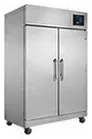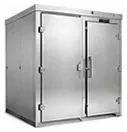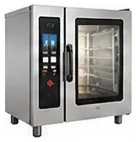
Cooling is one of the steps health inspectors look at closely. Under Colorado’s retail food rules, which follow the FDA Food Code, cooked food has to cool from 135°F to 70°F within two hours, and down to 41°F within the next four. A chiller that has quietly lost capacity can push a batch past those limits while everything still looks normal. We repair blast chillers and shock freezers, from reach-in models to roll-in cabinets, for catering companies, commissary and school kitchens, bakeries and restaurants across Colorado Springs and in Monument.
Signs it’s falling behind
- Cycles take longer than they used to with the same load.
- Probe mode ends early, never ends, or the probe reading doesn’t match a hand thermometer.
- Frost builds up on the evaporator, or water collects in the cabinet.
- The condensing unit trips, or the controller alarms partway through a cycle.
What usually causes it
- The condenser. A chiller has to reject an enormous amount of heat within minutes. Flour, grease and dust on the condenser — or a rooftop condensing unit working in thin air on a hot afternoon — stretch every cycle.
- Evaporator fans. Chilling depends on fast air moving across the pans, and losing one fan motor adds a long time to each cycle.
- Ice on the evaporator. Hot pans release steam, and that moisture ends up as frost on the coil. If the defrost heater, the termination sensor or the drain stops working, the frost grows into ice and blocks the air.
- Refrigerant or compressor. A slow leak or a worn compressor shows up as a unit that pulls down an empty cabinet but can’t handle a full load.
- Door gaskets and heaters. A torn gasket lets in warm, humid kitchen air: more frost, longer cycles.
Checking the food probe
With the probe in the food, the chiller stops when the center of the product reaches the set point — so a probe that reads wrong decides how long every batch chills. We check probes in an ice bath, which should read 32°F. The boiling-water check doesn’t work the usual way here: in Colorado Springs water boils at about 201°F, not 212°F. A damaged probe cable is a common and inexpensive repair.
Loading
Use shallow pans, leave space between them, don’t cover them during the cycle and stay within the rated load. If cycles still run long, it’s time for a service call. You approve the price before we start, and parts and labor carry a 3–6 month warranty.
Once the food is chilled, it goes into storage: see walk-in coolers, walk-in freezers and reach-in and display freezers.
Common problems we fix
- Chill cycle runs long
- Never reaches the target temperature
- Food probe reads wrong or shows an error
- Frost or ice on the evaporator
- Evaporator fan not running
- Compressor overheating or tripping
- Door gasket torn or door not closing
- Alarm or error code on the controller
Thank you!
We got your request and will call you back shortly during business hours (8:00 AM – 10:00 PM).
In a hurry? Call us: (719) 521-0025